
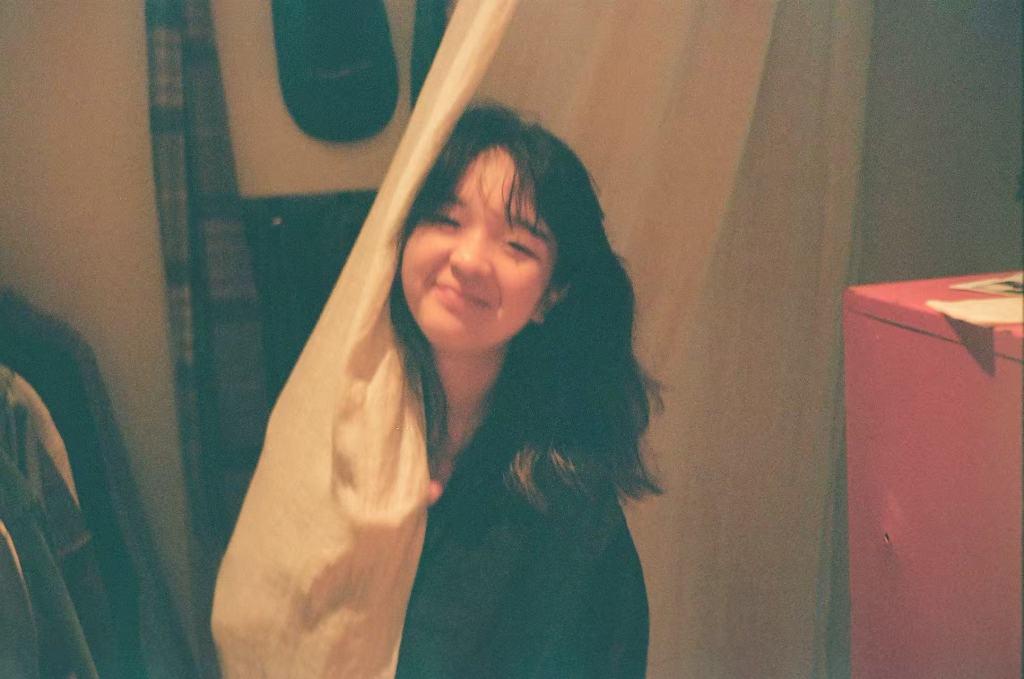
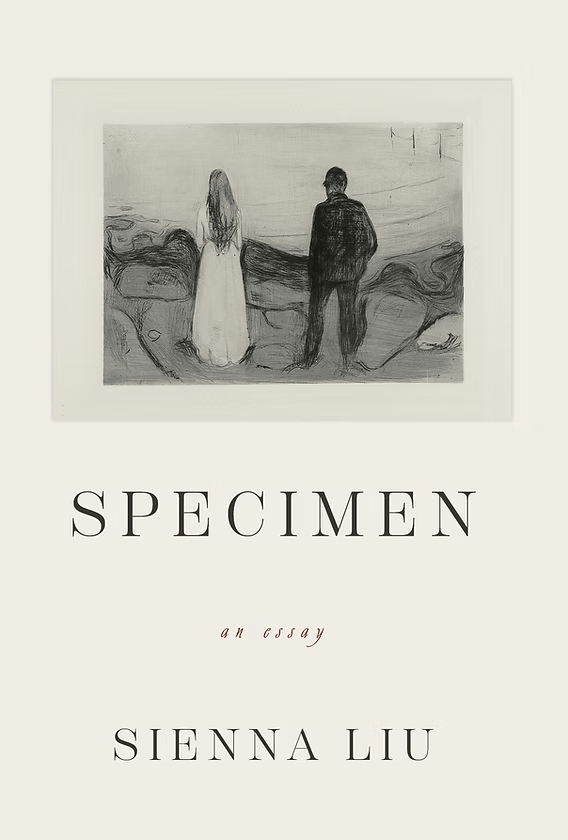
Sienna Liu is the author of the book-length essay Specimen (Split/Lip Press, 2025), the novel Food Porn (Game Over Books, 2024), and the poetry chapbook Square (Black Sunflowers Poetry Press, 2022). Her English-to-Chinese translations include Claire-Louise Bennett’s Checkout 19 (Shanghai Translation Publishing House, 2026), Rachel Cusk’s Second Place (Guangxi Normal University Press, 2023), Ali Smith’s Companion Piece (forthcoming), and a new translation of Virginia Woolf’s Mrs. Dalloway (forthcoming).
Article writer: Ariel Xinyu Peng
Hosts: Ariel Xinyu Peng, Ang Xu, & Lily Huang-Voronina
Podcast audio editor: Ariel Xinyu Peng
Article editor: Ang Xu
Specimen
Ariel Xinyu Peng (AP): What prompted you to write Specimen?
Sienna Liu (SL): Like the opening of the book, I met someone at a party, and something about him reminded me of someone else. It was as if I walked into a party and saw someone who was actually a writing prompt to me. After that “doppelgänger moment,” I started to write what I hadn’t thought I would be able to write.
AP: How long did it take you to write the entire book?
SL: The first draft took me about a month. I’m a very impulsive writer! If I’m obsessed with an idea, it’s hard to not think or write about it every day. I do this kind of sprint writing all the time. If I don’t write it, I will lose it forever.
AP: At the Craft Talk you had with The Writer’s Center in July 2025, you said that you wrote Specimen in order to understand, by writing, your relationship with the world and all the moving around, not having a sense of belonging, as if you were writing a detective story. Through writing this book, did you gain more understanding of yourself or did it feel like you gave out a piece of yourself?
SL: One thing that I’ve struggled with in both writing the book and talking about it afterwards is this temporal disconnect between the people I was writing about and me. Since the story happened a decade ago, I have long lost real connections with that world. However, I got a better understanding of the self at the time, though I don’t know if it’s because I’ve forgotten about the self in the decade in between. I also gained a new perspective on some of the people I wrote about. I think I gave a piece of myself long before I wrote the book; writing it was more of an act of retrieval.
AP: Has anything changed since you finished writing the book?
SL: It’s hard to connect with the vulnerabilities you had in your early 20s. After writing Specimen, I am able to see that a lot of my grievances towards E, the other person in the book, was actually more of a self reflection. I was angry with certain aspects of myself back then, which I projected onto him, because we were similar. He had a much different understanding of the relationship than I did, and I learned that while writing the book. Writing Specimen gave me the space of a few months to interrogate things from back then.
AP: You also said that part of you realized, as you wrote about E, that some people aren’t that special, since you met someone like him at the party. Can writing about someone be a process of de-mystifying them?
SL: To fall in love with someone, you have to create a myth or a fiction, otherwise, what’s the fun? 😈It’s the same with writing fiction or even reading it. The imaginative aspect and falling in love share the same mythical aspect of learning something new, which is also erotic. Once you start to be the detective and analyze what people really want or mean by a word, the mythical aspects begin to fade away, and you begin to see them as who they really are.
A personal project I used to conduct was to “demystify people,” as I wanted to see through someone’s pretenses, rather than seeing them as a type. I failed the project, especially when early on in a relationship, there is a lot of storytelling to each other. Writing about someone 10 years later is a process of trying to get to a truer version of things, though not the truest version, it’s one that I hadn’t thought about before.
Lily Huang-Voronina (LH): What helped unveil that truth?
SL: When writing Specimen, I was reading all the “primary sources”: text messages and my contemporaneous chats with others talking about E. Although this sense of objectivity is not pure because I’m still the same person, in a sense, I no longer need to prove anything to myself, such as finding traces of whether he’d loved me or not.
Doubles
AP: In your work, there is a motif of body double, parallelism of people who look alike. How does a person who is similar to you help you understand yourself, especially in the process of writing?
SL: Since a very early age, I could see similarities between people who would never meet in real life. I don’t know if it’s because of my narrative instinct that I see character prototypes. If one of your very cherished people has a special trait, you might recognize that in someone else, or you might feel a kind of affinity with them… the tendency of lovers and writers to turn coincidences into manifestations of fate. This applies to things, too. For instance, in the book there is a certain type of loneliness that I felt on two separate occasions which are so similar to each other that I blended them together. It might also be a narrative or writerly instinct to group your experiences into buckets in your mind, which also amplifies their differences.
Sometimes when I think about two very similar people, I can’t really tell their boundaries, and I start to impose one’s traits onto the other. (It’s bad, I know.) However, when I recognize something in others that’s really similar to something of myself, I could get a little defensive: I would not like that particular trait because I see myself in it. In a romantic relationship, if the two of you are similar in certain ways and you get into an argument, what you argue about might actually be what you both share. Therefore, similarity doesn’t necessarily promote mutual understanding. Sometimes it excites you to antagonize the other person if you don’t like that part about yourself. I need people who are a little bit different from me in my life in order to not feel like I’m in an echo chamber. Also for the narrative, right?
AP: You’ve told me once, “Romantic love is just you and your friends talking about it.” Could it be that the protagonist’s partner in a love story is less important than those they tell the story to?
SL: Yes, in a certain way, right? When the narrative capability doesn’t live up to your experience? The feeling of loss is something I often experience and try to convey. This might be a driving force for a lot of writers to recapture the magic of what they’ve felt in a moment. For romantic love stories, the telling of them adds complexity on top of the relationship. Back in college, all my friends and I shared details of our relationships, sending screen shots of chat and asking friends to analyze them for you. This web of interactions you have with your friends enriches the relationship. It’s not as though you are the main character in this story but that there’re so many people weaving stories around you.
LH: Somehow the most intimate and romantic love stories become the most societal because of all the telling. Why?
SL: When you are in an intense and toxic relationship, you feel very claustrophobic. That’s when I’d want to share the most, to have a support system around me and not be on my own in this difficult entanglement.
AP: In that way, do you write because you want to tell someone about it?
SL: In a sense, every writer would say yes, if they’re being truthful. If you only write and don’t send out your work or share it with your friends, maybe you’re only writing it to record it. For me, it’s not that I have a person or even a friend in mind but that I’m talking to someone through writing. I don’t know who that is. Sometimes I’m confiding in someone, and other times it’s more like, “I’m recording something and please take care of this manuscript,” to whomever I’ve imagined. I write mostly to make sense of what happened.
A second motive in writing Specimen might have been that my imaginary reader was the person I was writing about, even though I’m pretty sure he still doesn’t know that I wrote this book. I wanted to say, “Look, I understand you now. I didn’t fully back then or even try to. But you did something wrong, too.” To a very big extent, I was writing it for myself, to my former self, and for all the friends who’d listened to me all the time back then.
Editing
LH: Did you feel like you had to tailor your writing to a specific audience?
SL: I started editing based on feedback from my friends, who were my first readers, then from my editor. Together, they are like the symbol of “the readers” to me. I wasn’t tailoring the work to the reader in general—because you never know what the average reader wants these days—but to the people whose tastes I trust. I wanted them to be able to follow the story and find something in there.
AP: Since this book spans such a long time, how did you make sense of the timeline and piece the vignettes together?
SL: The first comment my editor gave me was that I should be more ambiguous in terms of time. In my very first draft, I had a lot of “on September, 21st, 2014, this thing happened…” She didn’t think that I needed to announce it every time. Since Specimen was my very first nonfiction writing, I was finding my way through it, and I thought that putting a date to an event would bring it closer to the truth.
A lot of the “back and forth in time” was driven by how memory works: When I think about something that happened 10 years ago, in my heart, there’s another memory that’s right next to it, even though it happened 2 years or 2 days ago. I digress too: when I was writing about one scene, and if that reminded me of another, I would just go there and be back when I am done. Things were based on my repertoire in my memory. In my editing process, I printed each vignette on a page and then shuffled them. Overall that was really fun!
AP: How is long form writing different from short form writing? Your short story “Your Own Poems” featured in Mother Tongue Journal’s debut issue also parallelled two men who were similar to each other. Could that have been a starting point for a Specimen?
SL: I’m glad you brought up “Your Own Poems!” 🩵The two were written very close in time and on an impulse: One thing happened, and it reminded me of another, and I started writing it one day at work. Although I labeled “Your Own Poems” as a short story, it’s actually closer to nonfiction. It gets clear when you’re writing a short story versus nonfiction. “Your Own Poems” also consists of vignettes and is an attempt to make sense of someone in a situation after many years have gone by. It is more of a satire, while Specimen is a more serious interrogation. A lot of the writings, a chapter or a vignette, is just a matter of length. Any writing necessarily involves transitions, and I use the vignettes form for a more fast-paced experience.
Translation and Being Multilingual
AP: Reading Specimen, my biggest question was, what is the effect you want to achieve by providing writing in both English and Chinese? For those who don’t read Chinese, would they be robbed of an experience, or is it meant to be jarring for them?
SL: I’ll start with why I included the Chinese: In most cases, it’s because I had experienced the event first in Chinese. If I had only included the English, it would be—I wouldn’t say a betrayal—not doing full justice to that memory. And I only provided the Chinese for the specific words or texts that had been stuck in my head, such as lyrics, what someone had said to me, and what I’d written in Chinese that had been thought of so often and became inscribed in my mind. I tried to find these exact words, otherwise I wouldn’t feel comfortable calling it nonfiction. This might be why people like to send screenshots: you want to do justice to the original, and you don’t want to paraphrase. I haven’t really thought of what that would mean to the readers who don’t read Chinese, and I’ve been asked this question by those who only know English. If you read Chinese you will have two levels of understanding of the same thing, and if you read one language you will get my translation.
AP: So the readers have to trust you on the translation.
SL: No, they don’t. At one point, I’d even thought of mis-translating on purpose, such as making the Chinese correct but doing something fun with the English and making it entirely different. But then I reminded myself this was nonfiction, so I might try that in a fictional work. Nonetheless, I don’t think the readers can trust me, to be fair, and they can’t trust me on the Chinese either because I mis-remember. In the book, I would even correct myself: for the longest time, I thought something was what E had written to me, and only when I started writing this book did I realize that this was actually something I’d written. What makes a work nonfiction is the intention to be truthful.
AP: I noticed slight discrepancies between the two languages as I read, though it’s my interpretation. For the readers who do read Chinese, they basically have to read the same content twice. What was your intention?
SL: You’re absolutely right… they have to read it twice, don’t they? I wanted to call attention to the fact that, as a non-native speaker, a lot of my writing is translating. For instance, I experience all these things in Chinese, and if I want to convey them to an English speaker, I’d have to translate my experience into English, which necessarily involves introducing discrepancies. I tried to keep my translations as accurate as I could, but you noticed discrepancies, which means you have a different understanding of the English versus the Chinese. This is the inherent limitation of translation. I also work as a translator, so I understand that limitation.
However, it’s fun to have two texts where one is the original, the experienced, and the raw material. I’m giving you the work product, and you can compare and decide if I did a good job. From the way I translate, maybe you’ll see how I make sense of things. This would be an added bonus for those who read Chinese.
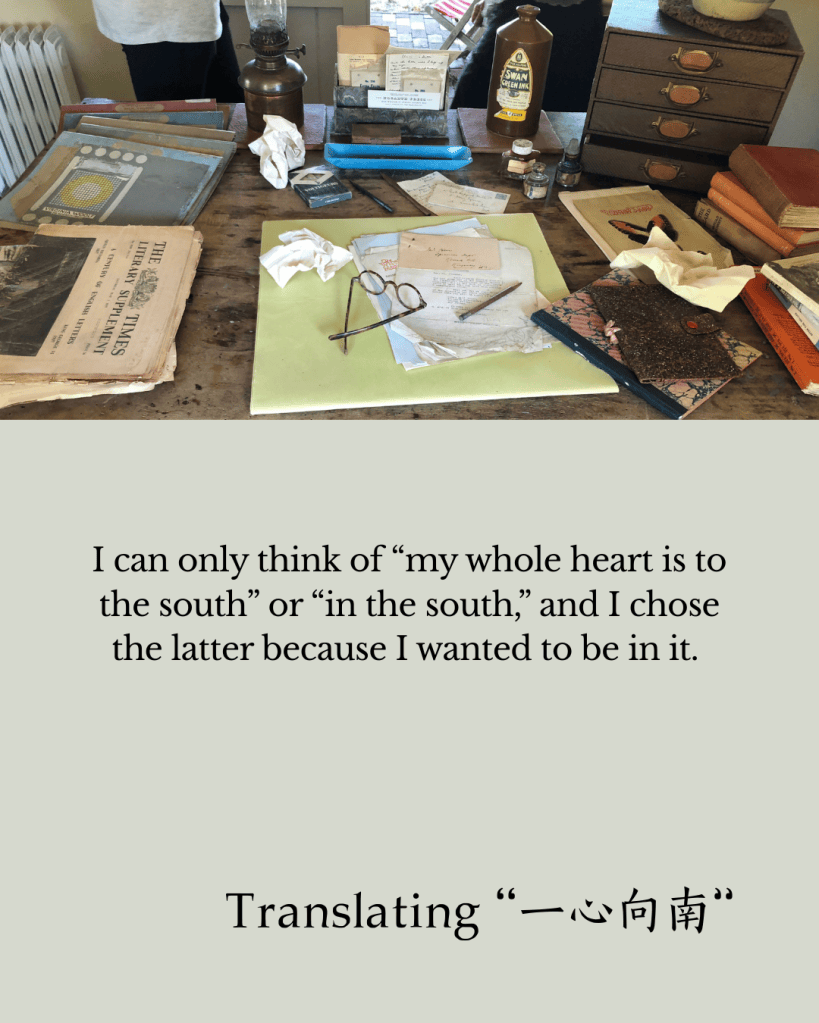
LH: There is a phrase in your book, 一心向南, that has so much potential, and you landed on a more literal translation, “my whole heart is in the south.” Why?
SL: Words carry weights, and there are certain expressions in Chinese that have a different weight than if you translate them into English because of how they were used in history. For instance, the movie 花样年华 and its English translation, “In the Mood for Love,” are totally different. It doesn’t capture the sense of melancholy that’s in the Chinese. I really don’t know how else you can translate 一心向南 into English to keep the flavor it has in Chinese. I can only think of “my whole heart is to the south” or “in the south,” and I chose the latter because I wanted to be in it. I can think of less literal translations too, such as “I dream of the south” or “I long for the south,” a translation upon a translation, but I always prefer a more literal one for Chinese. The imagery of the south is so different in Chinese, too. When you say “the south” in English, it loses everything compared to when you say 南 in Chinese. Since I decided to write the book in English, it’s inevitable that some things have to be lost, and I wanted to save at least a few things from the fire.
LH: How might love be different when it’s bilingual?
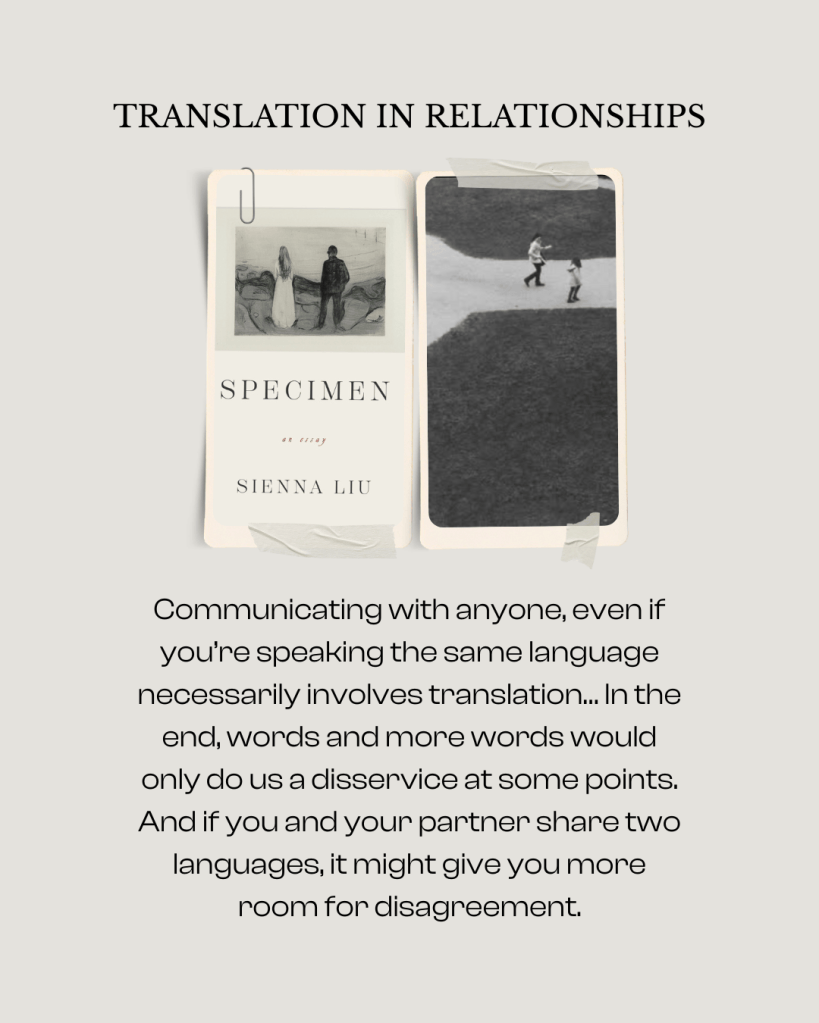
SL: For expats like us, a part of our personalities have migrated to English, a part of us is housed there. Communicating with anyone, even if you’re speaking the same language, necessarily involves translation. In the end, words and more words would only do us a disservice at some points. And if you and your partner share two languages, it might give you more room for disagreement.
AP: Might this be the point of displaying your writing in both languages, so then people would keep in mind that something is lost here?
SL: I always want to convey this…lossness.
Ang Xu (AX): What do you think of the idea of a mother tongue in your current writing life and personal life? Does that term still hold meaning for you? Or has it become something more fluid, more ambiguous, a kind of medium rather than a fixed identity?
SL: I may be able to write a novel in Chinese, but it’s doubtful, mostly because I’m so divorced from the whole society, not because I don’t know how to make use of the language. I would not be able to work or write a professional email or a paper in Chinese either. I still mostly dream in Chinese, and I think in Chinese when I’m really angry; those are the two mediums that are the closest, emotionally. I don’t speak Chinese until I get home from work, and if I didn’t have a partner who speaks Chinese, I probably wouldn’t speak it at all, living in New York. It’s more like a dream language to me, a dream scape where I create narratives. I’m digressing… but I do believe that people have qualities that won’t change, and you are able to forgive wrongs of people you love because you believe in their core or essence, and that essence is tied to a language.
AX: When did you start wanting to write in both languages?
SL: During Covid, when I was bored and confined in this little space, I thought of a very close friend who had once told me that they’d actually liked my writing in English more than in Chinese. I was really offended and started doubting my whole person, but I thought I should give writing in English a try. My English writing had been mostly for academics, and I’d written movie or book reviews in English because I’d wanted a bigger audience. Later I realized there is a certain freedom in writing in English, especially knowing that your parents would never be able to understand it, and that feels like a safe distance.
AX: When writing in a non-native language, is lyricism a poetic instinct for you, or is this something that you have to consciously pursue and construct?
SL: If it’s not your native language, you pay more attention to the words and the structure of the sentence. Non-native speakers are better at puns or other word plays, because they have to learn those words in the first place, as they are not natural to them. When I learn, I pay attention to the rhythm as well, how words sound. Native speakers take the language for granted more. Lyricism, or attention to language, is built into the fact that you are using it as a tool, like playdough! When I write in Chinese, I like wordplay and puns, too, which could be a personality thing, but I just love words. I like individual words, I like words put together, and I like thinking about them.🩵
AX: In the act of translation, what is the loss you most often grieve, and what has been the most unexpected gain?
SL: The one thing that I lament the most in my translation work is that sometimes you cannot do the pun. For instance, I was translating Companion Piece by Ali Smith, who’s notoriously known for her puns and wordplays. In the novel, there was a consistent wordplay between “curfew” and “curlew,” which also serves as an important thread throughout the novel. I went through lists and lists of birds in Chinese, and I was ready to go with a different kind of bird, just to have a same sound as the word curfew in Chinese, such as 宵禁 (xiāo jìn) or 解严 (jiě yán). Then I thought about going with a bird named xiao jin*, but it doesn’t exist. In the end, I had to add a footnote that said, “this bird and curfew have a similar sound in English.” I felt really bad. I thought about that for months and months, but I had to convince myself that it’s not doable at this point, let’s accept that and not make a mess.
*Later Sienna said that she wasn’t really sure what the characters should look like, but its name should sound like xiao jin.
AP: Why did you choose to use traditional Chinese characters for your book?
SL: That’s one question I wish people would ask me! As someone who was brought up in mainland China in the 1990s, I was not brought up to use traditional Chinese. It seems more refined, formal, and for me, more distant, and the distance is why I chose it. My original draft was in simplified Chinese, and when I looked at it, I felt too exposed. I felt as if I was showing people the raw materials. When I put the writing into traditional Chinese, it no longer felt like messages on my phone or my diary. The intimacy is lost in that translation. It could seem a little pretentious, but I like the distance.
AP: Why did you make the stylistic distinction to italicize certain paragraphs in the book?
SL: I tried to make a distinction between written and spoken words: if it’s spoken, it’s in quotation marks, and if it’s written, it’s italicized. I treated text messages as written words unless they had a feeling of urgency to it, such as if the text messages felt like people were talking, I would put them in quotation marks.
AP: Why is Specimen‘s title in Chinese 标本?
SL: I started out with 标本 and landed on Specimen. In the book, there’s a vignette about the butterfly, a very important imagery. The concept of 标本 also entails being a part of something whole, and I wanted to use this as an example of a relationship: two people who don’t work at all. Putting the whole event under the microscope, I wanted to instill the sense that we’re interrogating and inspecting, almost like you would with a scientific project or a detective story.
Nonfiction vs Fiction
AP: Was Specimen always intended to be a work of nonfiction?
SL: Yes, I rarely write nonfiction, mostly out of cowardice, as it has more of a demand on you as a writer to be more truthful with the writing. Fiction is a freer form of writing, and it allows you more liberty in how you structure a story. But with Specimen, I wanted to do it justice and present it as truthfully as I could.
AP: How do you do someone justice when writing in retrospect?
SL: It’s difficult, isn’t it? I question if something can truly be nonfiction, since everything is fabrication to a certain extent, such as your understanding of someone or your memory: is it really the truth, or is the fiction already baked into your memory? I think it’s the latter. When I write auto-fiction, I sometimes base an episode on someone I know or something I’ve truly experienced, but I want to have a happier ending than it did in reality. I could also fabricate my emotions so I could distance myself from the experience. This is not a liberty that is allowed in nonfiction. You cannot change history. Although not one individual could have a claim on the true history, you cannot change your true perspective of what happened.
On the other hand, I want those I care about to recognize themselves in my work—I don’t shy away from allowing people to recognize themselves in the “real fiction” I write. The beauty in writing fiction is that it could have happened, only that it didn’t, and I like to explore the space where all the possibilities are still there. Although it can be a little unclear to me where the line draws, especially when you’re writing auto-fiction, for me, it’s the intention or the commitment to the truth that matters.
LH: How do you discipline yourself in staying true to those intentions that matters?
SL: Writing nonfiction involves an investigation, and you have to fact check yourself for your interpretation of the events. I don’t want that interpretation or reaction to be performative either.
AP: If you need to fabricate parts of a story in order to make the plot smoother, why not work it to be nonfiction?
SL: If you are set out to write fiction, every step of the way you can lie or imagine. I could have written my first novel Food Porn as nonfiction, of which 75 % might have been, but very key aspects of it were fiction. That’s where the imagination, protection, and other possibilities come in. For instance, the first vignette in Food Porn takes place at a literature seminar where a professor was saying something, and this exact thing said by the professor was entirely real, but what the narrator did and struggled with afterwards were totally made up. The fiction route of writing is more carefree and lighter for me, in a sense that I don’t feel that I have to be held accountable.
AP: Yes, a big part of writing nonfiction is holding yourself accountable for the readers, and that’s a choice.
AP: In this age of common performativity, especially in nonfiction, which tends to be associated with “trauma porn,” how do you lay yourself bare on the pages? How do you decide which line of story in your life to pour onto the pages?
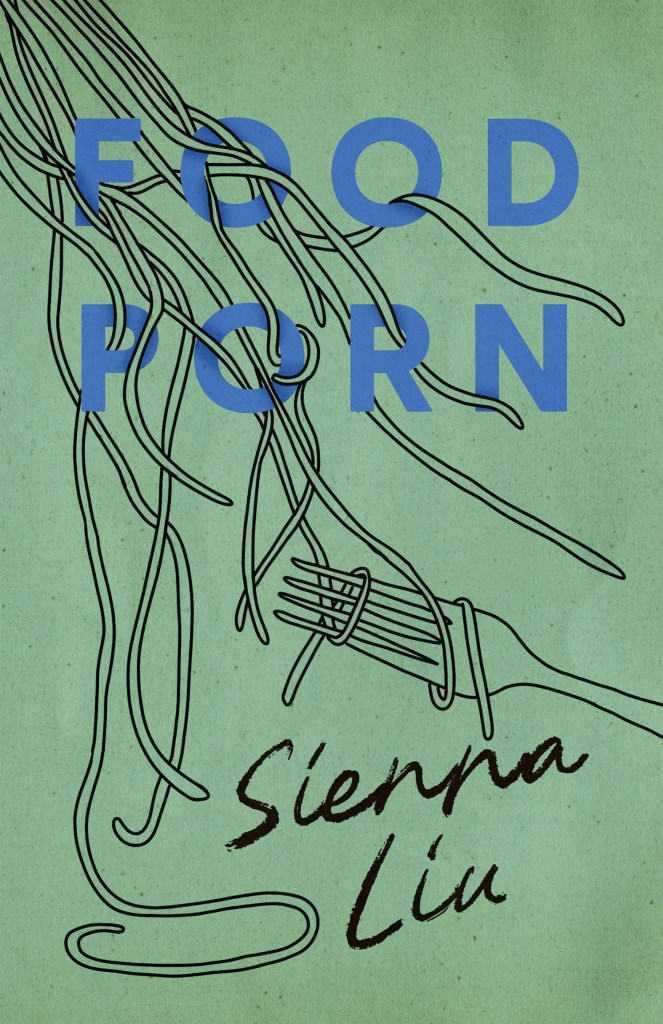
SL: It’s tempting to be performative, especially in fiction. When I’m writing nonfiction, there is more of an “I,” though it’s not completely “I” because you still have this temporal distance than when you write in the first person in fictional work. I write mostly in the first person, so the narrator usually is very performative, as I would think about the kind of images that the character would want to project to the readers.
Meanwhile, the tone in Specimen is less flowery than in Food Porn. In Food Porn, I was obsessed with using puns and sounding witty, because the “I” in the book was a fictionalized real person. It is different than when a writer examines the past in the role of an archaeologist or a scientist, whose mission aligns more with the truth than with making the story more interesting. Therefore, nonfiction seems less performative for me, and I do less of the gimmicks that I sometimes find tempting in fictional writing. In my nonfiction work, I’m just a conduit for whatever needs to be conveyed. I’m showing you the specimen as evidence.
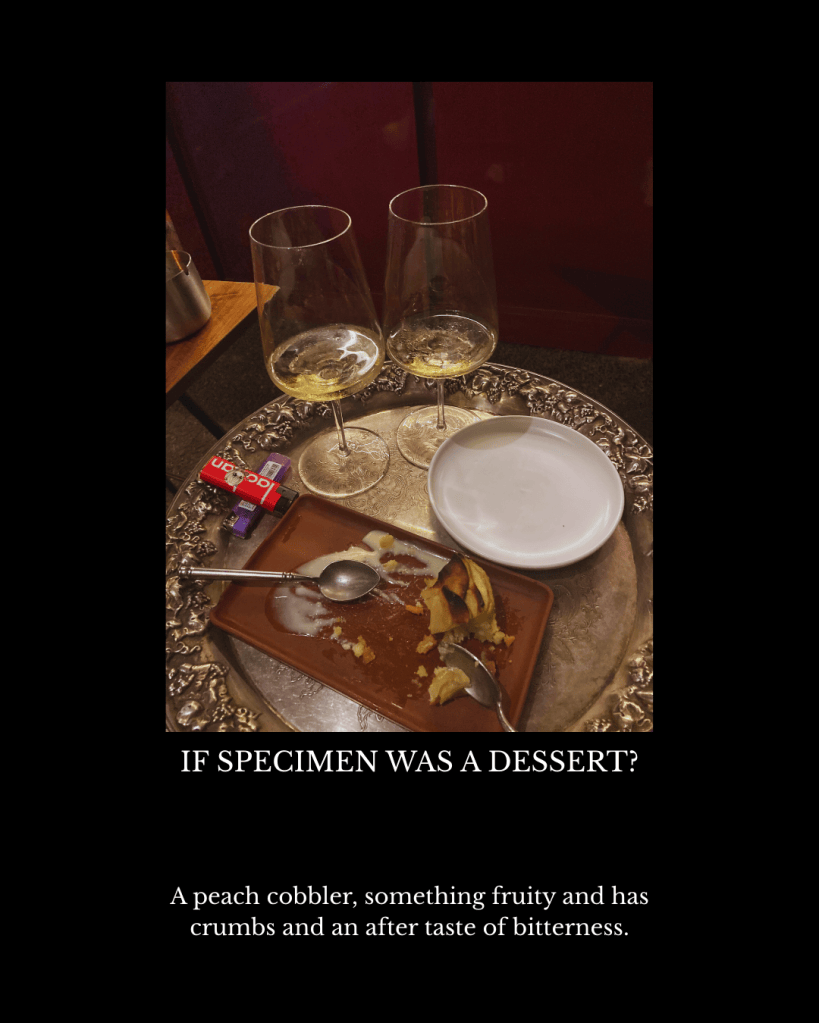
AP: If Specimen was a song, a movie, or a dessert, what would it be?
SL: For the theme song, my first choice is “My Funny Valentine,” and my second choice is “Wicked Game,” which I listened to a lot when writing. A dessert might be a peach cobbler, something fruity and has crumbs and an after taste of bitterness. There’s contrasting textures, the soft, the moist, with the crunchy part, but also that bitterness that’s baked into it, no puns intended. As for a movie, Specimen would remind me of a documentary about the sea or sea life, something that’s visually very blue and very chaotic.
Life and Other
AX: You are a full-time lawyer in a big firm in New York City. How do you balance life as a writer and a lawyer?
SL: It’s hard because you need to take breaks from both your day job and your writing. Perversely, however, having a day job helps with the writing, because it shows you how little time you have. I might have only started writing when I started working. Every day I think about how I only have 1 hour today for myself: What am I gonna do with it? Do I watch television for an hour or do I write for 30 minutes and read for 30 minutes? I hope I usually choose the latter, but I don’t always. The most important thing is that you have to want to write.
AP: What are you currently reading? What is one book that will always stay important to you?
SL: I recently finished Eros the Bittersweet by Anne Carson. It was so good. I love her. I am the type of reader who would binge read someone’s work. I also like Javier Marías and Natalia Ginzburg. When working on Specimen, I thought about Annie Ernaux and Maggie Nelson. Last year I read In Search of Lost Time, the full volume in English, Lydia Davis’ translation for the first volume and the Modern Library version for the rest. It was one of my favorite experiences so far. I wish I hadn’t read it so that I could read it for the first time again. I enjoy long work. It’s like having a book’s company for at least a few months. But I’m also partial to works that are under or around 100 pages.
AX: I remember a few years ago, you made the decision to read only books by women authors for an entire year. How did you feel at the end of that year?
SL: It wasn’t a conscious decision from the get-go : midway through that year, I realized that I’d only been reading female writers. Around that time, I read a book by Claire-Louise Bennett, who’s now one of my favorite writers. I also translated one of her books into Chinese. In her (sort of) auto-fiction Checkout 19, she talks about her subconsciously beginning to not read male writers at a certain point onwards and how liberating that has been. She says that it was a year when she stopped reading about men, writing about men waiting for a taxi, men going to a train station and flipping a coin following a woman in a trench coat, men going through the swing doors, men ordering a martini at a bar, thinking about men stuff, and men doing this and that… And at the end of that year I also felt wiser, more tender, less angry, less aggressive, less entitled in a way.
AP: Do you believe that the artists and the work are separate in this age? How should we read now?
SL: Growing up, I didn’t even realize that the writers I’d liked were men, because I somehow thought they were all the same, like I could be Tolstoy or Nabokov, what is the difference there? I only noticed this after I came to America, and it was pointed out to me that the Western canon is all white men. For a long time, I didn’t know how to reconcile that with the fact that I do like some of these men’s writing, especially some of these clearly misogynist men’s writing, eg. Henry Miller. There cannot be good writing that is immoral, in my book. You can be a bad person in life, but if that taints your writing, it can’t be good. For instance, the parts of Henry Miller I enjoy are those that are separate from the misogynist part of him, so you can treat writers and their work separately. However, you can’t completely divorce a writer from their writing either, though as a critic you can appreciate one’s work while disagreeing with their politics, given that it doesn’t complicate the particular writing. If you read something and have a visceral reaction to it, that’s a good enough reason to reject that writer.
AP: How much of Shanghai, which is (sort of) your hometown, do you identify and carry with you nowadays?
SL: I didn’t identify Shanghai as my hometown for a very long time. I left Shanghai in 2013, and it was a good time to be a teenager in Shanghai. When I was growing up, it was so much fun, very liberal too. I do tend to romanticize that memory. However, the last few times I went back, I felt a disconnect with the city. I felt that it had moved on without me, like it had its own agenda. The last time I went back, I said to my friends that I was no longer on familiar terms with this city, and I could not use the informal speech with the city—I could only say vous not tu, because I didn’t know you anymore. I feel less of a distance with New York.
AP: I suspect it’s because you have done plenty analysis in New York than you did in Shanghai.
SL: The day-to-day reckoning.
AP: What is an indication that you belong somewhere?
SL: I don’t know if I ever truly feel that I belong somewhere, but I do feel whether I’m not welcome somewhere. There are also situations where I feel that I’m not totally in sync with my hometown anymore, and I’m not totally in sync with a lot of the places I’ve lived in.
AP: I’ll attempt a translation of something you’ve once said for the closing remark: “It seems that I understand you, but we only read the same book.” Access to the same information does not guarantee the same level of understanding, especially in this age, we’re contaminated and overexposed in literature, movies, art, etc. There’s an anchoring point that you hold on to, but maybe it’s to confirm your own existence, especially for diasporic people who are trying to find roots or a sense of belonging. But sometimes we forget to notice that there’s a bigger world out there.

